Roulette First, Baccarat Last: A Beginner’s Low-Stakes Table Route for 2026
Live casino lobbies can feel like a duty-free perfume hall: bright, busy and full of bottles you are not quite sure you should open. Roulette, blackjack and baccarat are the three classics most UK beginners recognise, but recognising a game and knowing how to sit down at it are different things. This is a simple route through all three in 2026 — not a masterclass, just a low-stakes way to find out which table suits your attention span, your nerves and your idea of a good evening in.
The idea is to treat the three games as a short course. You are not trying to become the sharpest player in the room. You are trying to learn what each table asks of you, how quickly it moves, and whether you actually enjoy it. That last point matters more than most guides admit.
Why a table crawl beats a crash course
Most beginners make the same mistake: they pick one game, read five conflicting articles, and then sit down with a head full of jargon and a wallet full of hope. A table crawl works better because it separates the games. You give each one a short, capped trial, then compare how they felt. Roulette is visual and layout-led. Blackjack is decision-led. Baccarat is rhythm-led. Trying them in that order gives you a gentle ramp rather than a cliff edge.
It also makes safer play easier. When you know each session is short, you are less likely to chase a loss from one table onto another. The point is to learn, not to prove anything.
First chair: roulette — learn the layout, not the legend
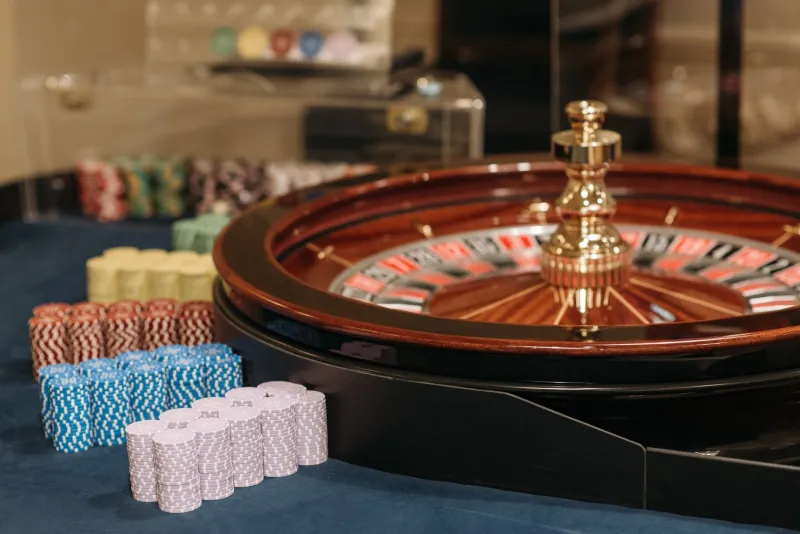
Roulette is the natural starting point because you can see what is happening. The wheel spins, the ball drops, and the layout tells you what pays what. In the UK you will mostly meet European roulette, with a single zero. That matters: the single-zero wheel has a house edge of around 2.7%, while the double-zero version — more common in some US-facing rooms — is closer to 5.26%. If you have a choice, the single-zero table is the kinder classroom.
The main split is between outside bets and inside bets. Outside bets cover red or black, odd or even, high or low, and dozens or columns. They pay less, but they cover more of the wheel. Inside bets — single numbers, splits, streets — pay more and land less often. For a first trial, outside bets are the sensible handrail. You are there to learn the pace, not to hunt a 35/1 miracle.
What it asks of you: attention to the layout and a bit of patience. Roulette is not a decision-heavy game, but it can be hypnotic. That is exactly why you should set a spin limit before you start.
A sensible trial: pick a low-stakes table, set aside a small amount such as £10, and play 15 to 20 spins using simple outside bets. Notice how long that takes. Notice whether you are watching the wheel or just clicking. Stop at the limit, win or lose.
Second chair: blackjack — one decision at a time
Blackjack looks more complicated than it is. The aim is simple: get closer to 21 than the dealer without going over. Number cards count as face value, picture cards count as 10, and an ace can be 1 or 11. The dealer usually stands on 17 or higher, depending on the table rules. That is most of the rulebook you need for a first sit-down.
What makes blackjack different from roulette is that you are making choices: hit, stand, double, split. That is also where beginners can tighten up. You do not need to memorise a whole basic strategy chart on day one, but you should know that blackjack is not a game of wild guesswork. The house edge can be relatively low — often under 1% with decent rules and sensible play — but it rises quickly if you take insurance every time it is offered or chase side bets.
What it asks of you: a little concentration. Blackjack moves faster than roulette, and the decisions come at you in bursts. If you are unsure, slow down. A live dealer will wait. This is not a race.
A sensible trial: choose a low-limit table, keep a basic strategy card open on your phone or a second screen if the table allows it, and give yourself 15 minutes. Avoid insurance and side bets for now. You are learning the rhythm of the decisions, not trying to outthink the dealer.
Third chair: baccarat — the calmest rhythm
Baccarat has a reputation for being fancy. In practice it is one of the simplest table games in the building. You choose Player, Banker or Tie. Two hands are dealt — one for the Player, one for the Banker — and the hand closest to 9 wins. Tens and picture cards count as zero, aces as one, and cards 2 to 9 at face value. If the total goes over 9, you drop the tens digit. That is the arithmetic done.
The draw rules are automatic, so you do not have to decide whether a third card is dealt. That makes baccarat a good third stop: the pace can be brisk, but the decision is tiny. The Banker bet usually carries a slightly lower house edge than the Player bet after commission — often around 1.06% versus 1.24% — while the Tie bet is a much longer shot with a much bigger edge against you. For a beginner, Player and Banker are the only two boxes worth worrying about.
What it asks of you: very little, which is both the appeal and the risk. Baccarat can lull you into autopilot. Keep the stake low and the session short.
A sensible trial: play 10 to 15 hands at the minimum stake, sticking to Player or Banker. Skip the Tie. Watch how the shoe works and how the dealer announces the result. Then stop and compare it with the other two.
The practical route: one evening, three short stops
A simple plan for a UK beginner in 2026 looks like this. Set a total budget you are happy to lose — £30 is plenty for a learning session — and split it into three £10 blocks. Give each table around 15 minutes. Do roulette first, blackjack second, baccarat third. Keep notes on your phone: which game felt clearest, which felt too fast, which one you would play again.
Before you start, check the table limits. A £10 block goes further on a 50p or £1 minimum table than on a £5 table. If you are using a casino bonus, read the wagering rules first; table games often contribute less than slots, and some games are excluded. A bonus that looks generous can be a poor fit for a table-hopping evening.
And when the three stops are done, stop. Do not add a fourth chair because you are enjoying yourself. Enjoyment is not the same as a green light to keep spending.
Pace, edge and attention at a glance
- Roulette: moderate pace, around 2.7% house edge on single-zero wheels, layout-focused.
- Blackjack: faster decisions, often under 1% with good rules and sensible play, concentration-focused.
- Baccarat: brisk but simple, around 1.06% on Banker and 1.24% on Player, rhythm-focused.
These numbers are guides, not promises. Rules, commissions and table variants change the maths. The bigger point is that each game asks something different of you, and the one you enjoy most may not be the one with the lowest edge.
Safer-play reminders before you sit down
Keep it to money you can afford to lose, and treat the evening as entertainment rather than a side hustle. Set a time limit as well as a spending limit. Use deposit limits, time-outs or self-exclusion tools if you need them — UK-licensed casinos are required to offer them. If you feel yourself chasing a loss, or playing past the point you planned, stop and take a break. GamCare and BeGambleAware are there for confidential support, and they are not just for crisis moments.
A first table crawl should leave you with a bit more confidence and a bit less mystery. Pick the game that felt natural, keep the stakes small, and leave the bravado at the door. Big wins are nice. Knowing when to stand up is nicer.